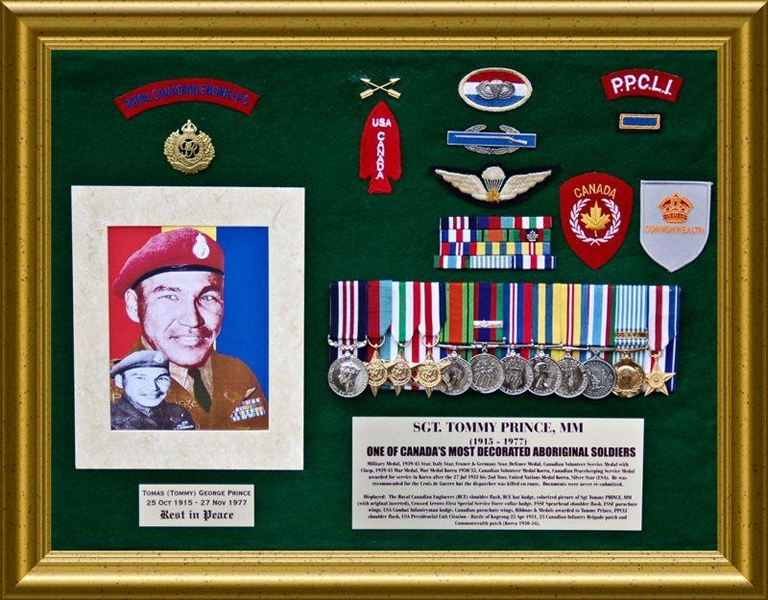
Sergeant Tommy Prince is one of Canada’s most decorated Indigenous war veterans, and he started his military service as a Sapper. Born in 1915 in the Brokenhead Ojibway Nation, he enlisted in the Canadian Army in June 1940, during the Second World War.
Prince was assigned to 10 Field Park Company, Royal Canadian Engineers, where he served as a Sapper for two years. He then volunteered for the 2nd Canadian Parachute Battalion in 1942 and was selected for the 1st Canadian Special Service Battalion.
Prince was awarded the Military Medal for bravery in Littoria, Italy, on 8 February 1944. While deployed forward in an abandoned farmhouse near enemy lines, their communication lines were severed by enemy shelling. Under direct enemy observation, he donned civilian clothes and covertly repaired the lines. His observations led to the destruction of four enemy positions.
Prince earned the US Silver Star on 3 September 1944 near L'Escarène, France. Patrolling deep behind enemy lines to observe enemy positions, he tracked 70km over mountainous terrain. His reports enabled the destruction of German positions and the capture of some 1000 soldiers.
Tommy was honourably discharged just before the end of the war. Like many Indigenous veterans, he was treated poorly upon his return home. Despite his heroic wartime contributions, he faced discrimination and was unable to find work. Undeterred, he launched a successful business. However, he quickly realized this wasn’t the right platform for advocating for Indigenous rights. Prince then left business to serve as a spokesman for the Manitoba Indian Association, where he lobbied the federal government for changes to the Indian Act. In 1947, he testified that the Indian Act should be abolished, that existing treaties should be respected, and that schools, living conditions, and hunting rights should be improved.
Sergeant Prince left politics to reenlist in the army in 1950 when volunteers were being sought for the Korean War. Serving with the Princess Patricia’s Canadian Light Infantry, he returned home in October 1951 with his unit. The following year, he volunteered for a second tour. Despite serving with honour, battle weariness took hold, and he was once again sent home. He was honourably discharged in 1952 with eleven career medals.
Sergeant Tommy Prince was a decorated soldier and cultural warrior, fighting to prove the worth of Indigenous persons and overcome racism and division. He is honoured across Canada through his gravesite and numerous memorials. Parks Canada has designated Sergeant Prince as a National Historic Person.