




By Capt Stephane Michaud (Ret’d), pictures by Louise Taylor, Canadian Red Cross
Having remained in Haiti following the CF Earthquake Relief mission (Op Hestia) that took place from January to March 2010, I had the chance to witness, week after week, the legacy left behind by the Engineers. Eighteen months after the quake, and days away from ending my mission as head of the Canadian Red Cross in the country, I propose this brief article to highlight the great and lasting work done by the Sappers.
At 16:53 on January 12, 2010, the most densely populated part of Haiti was struck by an earthquake of a 7.3 magnitude on the Richter scale. The order to deploy the DART was issued almost immediately after. Given the magnitude of the catastrophe – with early reports of 300,000 dead and over 1,000,000 made instantly homeless – it quickly became clear that a more robust contribution would be required from the international community in general, including the Canadian Forces. Consequently, a CF Joint Task Force numbering up to 2,050 was quickly assembled and deployed to the disaster zone. The main engineer component of this JTF consisted of a Squadron (+) from 5 RGC dispatched to Leogane, the town closest to the epicentre.
Disaster relief activities, following a sudden catastrophe such as an earthquake, are typically divided into three phases:
- emergency assistance (including search and rescue operations) to save the lives of those immediately affected by the disaster;
- recovery operations to bring the affected areas back to pre-disaster baseline or minimum humanitarian standards (whichever is highest); and
- development, the longer-term approach by which an affected area is strengthened beyond the pre-disaster baseline to reduce the likelihood, the impact of future disasters or both.
The recovery phase is further divided into early and late recovery. In early recovery, there are two main goals:
- prevent the secondary effects of the disaster (such as populations dying of thirst or the spread of vector-borne diseases); and
- create the conditions for late recovery (when an area is brought back to an acceptable humanitarian standard), namely by re-opening lines of communications, strengthening local governance systems and rebuilding basic, temporary infrastructure.
When militaries are deployed to take part in international disaster relief operations, they are typically called upon to assist with the tail end of the emergency phase (as it is almost impossible to deploy into a foreign state early enough for Search and Rescue operation – a task usually covered by the emergency services of the host nation) and early recovery1. Military interventions are employed as a stop-gap measure to allow for humanitarian actors – International Organisations and NGOs – to raise funds and gather their resources, a process that usually takes around 40 days. That is the mandate that was given to the Engineer Squadron, part of a 3 R22R battle group.
To efficiently support late emergency and early recovery operations, the Engineer sub-unit, based on 55 Support Squadron, 5 RGC2, was custom tailored for probable tasks including mobility support/road repairs, water treatment, debris removal, demolitions, constructions and general engineering support. With a strength of 110 members and up to 78 vehicles, it was organised into a Support Troop (two water production detachments, a large Heavy Equipment Section and a large Construction Section), a Field Troop (recce and three sections, two of which were outfitted as demolition sections complete with heavy excavator and three dump trucks each), an SQME section and Sqn HQ. Given the non-existence of any public works department in a town where 78% of all the infrastructure was destroyed beyond repair, there was no shortage of work. Through UN coordination mechanisms and in close collaboration with Battle Group CIMIC and local authorities, the CF Engineers quickly became the engineering service providers for all humanitarian actors. In a mere six weeks of operations, 147 viable projects were identified to meet the criteria of late emergency/early recovery operations. Of those, 98 were completed, and the majority of the remaining tasks were handed over to Korean UN Engineers who deployed to Leogane to take over from the CF a few days before the end of Op HESTIA. The preparation of their compound was one of the 98 projects.
Other projects were focused on reopening lines of communication, such as the mountain road between Jacmel and Leogane (Route 204, closed by landslides in 12 areas), removing debris clogging the streets, demolishing unsafe structures, identifying and freeing human remains trapped in rubble (to be handled by local “mortuary” services3), removing rubble from lands to be used for emergency structures (relief warehouses, clinics, UN compounds, etc.), providing water for distribution by NGOs, supporting local emergency structures (such as the local town hall, schools), building transitional structures such as medical clinics and assisting humanitarian actors in their own tasks, including digging and building latrines, preparing pre-fabricated shelters and preparing sites for displaced persons.
As I had the chance to remain in Haiti as Head of Operations and later Country Representative (Head of Mission) of the Canadian Red Cross, I have been a direct witness to what happened when the Sappers left. As is normal in these situations, international organisations (such as the Red Cross) and a large variety of NGOs took over providing humanitarian assistance. The effectiveness of these agencies and their actions is not to be debated here. I will only write that the CF are greatly missed by the authorities in Leogane and Jacmel. Since elements of the Canadian International Development Agency (CIDA) were present along the military (as is now typical in Canada’s “whole of Government” approach to foreign policy), they played a role in ensuring continuity of action in these areas. The Canadian Red Cross actually received CIDA funds to build semi-shelters precisely in Jacmel and Leogane, where we are to this day (4,000 units built so far, on as many individual plots).
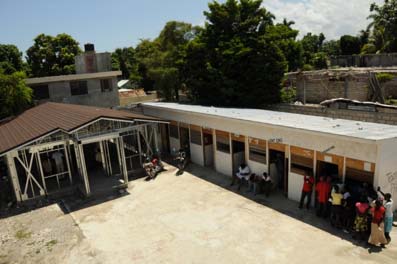
Of course, it is difficult to visually grasp the contributions of the Sappers, as it is impossible to photograph over 5,000 tonnes of debris removed from the streets, 2,000,000 litres of water distributed, landslides removed, etc., but there are a few lasting examples, testaments to the quality of the work: both clinics built by the Construction Section are still up and running, complete with ceramic floor, air conditioning, individual patient rooms with toilets, power (paid for by CIDA) and all accessories. The municipal government still operates from the temporary mayor’s office pictured above. The NGO warehouse site prepared by the Heavy sections is still in business to this day, and most carpenters trained at the engineer camp on a joint CF/CIDA project now work for other agencies, including the Canadian Red Cross, who also employs Frandy Saint Val, one of the first Op HESTIA interpreters. The Korean engineers still struggle to maintain the mountain MSR re-opened by the Engineers.
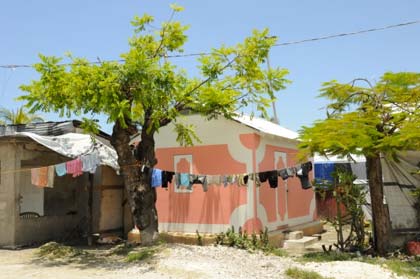
Most Haitian carpenters trained at Camp CHIMO still work for NGOs at building shelters such as this one (of 4,000) Canadian Red Cross shelters already erected (the beneficiaries choose their own color.) For the sceptics at the time: It seems that you can indeed use an engineer variant of the M113 to build foundation posts. Not an inch of vertical movement over 18 months despite floods and a hurricane.
Not often are Engineers (other than the DART close support troop) deployed with a humanitarian mandate. With versatile capabilities and legendary resourcefulness, the results they can achieve in a short time can be quite impressive, however, as was the case in Haiti.
Notes:
- The principles for military intervention in disaster relief are actually framed by the “Oslo Guidelines on the use of foreign military and civil defence assets in disaster relief” as well as B-GJ-005-307/FP-040 Humanitarian Operations and Disaster Relief Operations.
- Reinforced with elements of 4 ESR, 3 ASG, CFSME, CTSE and URSC St-Jean.
- One man with a wheelbarrow, garbage bags and Javex.