This Day in History

This feature will post  a short description of a significant event that happened on this date at some point in our history.  Interested viewers will be able to follow links to an expanded description of the event. 

The SEARCH feature will allow viewers to look up any date and find the corresponding event. You need to type the date in the format 'Month date'. For example, "June 9" (with quotations) will return events for any year that occurred on on that day.  Similarly, typing 1884 will find any entry with the year 1884 in the text.

You can also enter words that might be in the text of the entry.  For example, typing bridge will return all entries containing the word 'bridge'.  To narrow your search, you can enter more than one keyword, separating them with commas.  For example, typing bridge, Bailey will return entries about Bailey Bridges. 
This Day in History

Use quotes for exact matches,
e.g., "June 1".

September 6, 2009

On this day in 2009, a roadside bomb exploded killing Maj. Yannick Pepin and Cpl. Jean-François Drouin of 5 Combat Engineer Regiment deployed with the 2e Batallion, Royal 22e Régiment Battle Group in the Dand district southwest of Kandahar city.


September 6, 2009

On this date in 2009 a roadside bomb killed Maj. Yannick Pepin and Cpl.Jean-François Drouin of 5 Combat Engineer Regiment stationed in Valcartier, in the Dand district, southwest of Kandahar city, Afghanistan.

September 3, 2006

On this date in 2006, Cpl Clinton John Orr put himself at great risk to rescue soldiers trapped by enemy fire. He was awarded the Medal of Military Valour.

September 3, 2006

On this day in 2006, Corporal Clinton John Orr of 23 Field Squadron, won the Medal of Valour while rescuing fellow soldiers during Operation Archer in Afghanistan while under fire.

July 7, 2002

On this date in 2002, 12 Field Engineer Squadron of 1 Combat Engineer Regiment destroyed 11,340 kg of enemy ammunition and weapons in Afghanistan.

April 27, 2001

On this day in 2001, the CFB Chilliwack Historical Society was incorporated to preserve the heritage of the CME family in and around the base.

February 21, 1997

On this date in 1997, 1 CER constructed a 60 metre Acrow bridge over the Battle River at Auburndale AB to replace one damaged during the previous summer.

April 14, 1992

On this date in 1992, Sappers from 4 CER were engaged in mine clearing at Ilok, Croatia.

July 11, 1991

On this day in 1991, 1 Combat Engineer Regiment provided medical treatment and refuge to 1,200 American soldiers after an explosion in a U.S. Army ammunition depot in Kuwait. The Regiment received a Chief of the Defence Staff Commendation for its actions.

April 12, 1991

On this date in 1991, 1 CER deployed to Kuwait. This was the first complete combat engineer unit deployed since the Korean War.

November 6, 1990

On this date in 1990, 45 Field Engineer Squadron completed building a Load Class 20 Non-Standard Bridge for the local school board on Beechmont Road, Cape Breton.

March 20, 1989

On this date in 1989, Sgt Dan MacPhee of 45 Field Engineer Squadron was chosen as the only Militia member of the Canadian Military Engineer team sent to Pakistan to instruct on mine clearance.

May 14, 1988

On this date in 1988, 56 Field Engineer Squadron completed a suspension bridge over Wallace Creek in Gros Marne National Park.

August 23, 1986

On this date in 1986, 56 Field Engineer Squadron completed an Acrow bridge over the Dyke's River in Labrador in support of Air Command.

October 25, 1981

On this date in 1981, 56 Field Engineer Squadron completed a Bailey bridge leading to a Boy Scout Camp at Northwest River near Port Blandford, NF.

November 17, 1978

On this date in 1978, Lt-Col C.N. Mitchell passed away in Mount Royal QC.

May 8, 1976

On this day in 1976, an advance party of Canadian Forces personnel departed Lahr, Germany for an earthquake zone around Fruili, Italy. The operation involves the medical corps, a squadron of field engineers, and helicopters and their crews.

October 14, 1972

On this date in 1972, the RCE Museum was redesignated as the Canadian Military Engineer Museum and in July 1973 was granted official museum status by National Defence Headquarters.

May 7, 1972

On this date in 1972, The Trans-Canada Highway bridge over the Petawawa River collapsed. In a short period, 1 Field Squadron constructed a detour route including a two-span Bailey bridge.

September 4, 1971

On this date in 1971, following two years of work by 3 Field Squadron and 1 Construction Engineering Unit, the Ogilvy River bridge on the Demster Highway was handed over to the Yukon Territory.

August 14, 1971

On this date in 1971, the statue of Lt-Col John By, RE, was unveiled in Major Hill's Park, Ottawa.

September 15, 1969

On this date in 1969, the Canadian Military Engineers were assigned the responsibility to train and maintain Combat Diving resources for the Army.

January 2, 1969

On this date in 1969, the Royal Canadian School of Military Engineering was renamed to the Canadian Forces School of Military Engineering.

July 1, 1968

On this date in 1968, 5e Escadron de Genie du Canada was formed to be part of 5e Groupement de Combat in Valcartier, QC.

April 8, 1968

On this date in 1968, 1 Airborne Field Squadron was established as part of the Canadian Airborne Regiment.

February 6, 1968

On this date in 1968, Bill C-243 was passed - formalizing the restructuring of the Canadian Forces into a single, unified force. Three years later the Military Engineer Branch emerged.

February 1, 1968

The personnel and organization of the Royal Canadian Navy, the Canadian Army, and the Royal Canadian Air Force were unified into a single organization, the Canadian Forces.

November 3, 1967

On this date in 1967, 2 Field Squadron demolished the Hawkshaw Bridge over the Saint John River in New Brunswick at the request of the Province.

September 20, 1967

On this date in 1967, 56 Field Engineer Squadron completed the restoration of the Quidi Vidi Battery as a Centennial project.

October 19, 1966

On this date in 1966, 3 Field Squadron began work on 40 miles of road improvement and the construction of a bridge to provide access to the Nemaiah Valley, BC.

October 13, 1966

On this date in 1966, the Army Survey Establishment was redesignated the Canadian Forces Mapping and Charting Establishment.

February 5, 1966

On this date in 1966, the Chief of Technical Services, Lt-Gen LGC Lilley (former RCE), announced that the base Construction Engineering organizations of all three Services would be realigned in accordance with a standard organization.

October 10, 1965

On this date in 1965, Regional Construction Engineers Offices were established in Halifax, Montreal, Toronto, Winnipeg, and Vancouver.

January 28, 1961

On this date in 1961, the works section of the United Nations Emergency Force (UNEF) completed an extensive renovation program at Sharm El Sheikh.

July 21, 1958

On this date in 1958, Engineer elements fighting forest fires threatening Whitehorse were stood down as the fires died down.

July 14, 1958

On this date in 1958, Military Engineer personnel were employed fighting a forest fire that threatened Whitehorse, YK. Several fires also occurred in other locations.

Ripple Rock Explosion

On this date in 1958, Ripple Rock, a shipping hazard in Seymour Narrows between Vancouver Island and the BC mainland just north of Campbell River, was removed as a result of the world's largest non-nuclear explosion to date. The Project Manager was a retired RCE officer.

October 17, 1957

On this date in 1957, the 2,130- foot long suspension bridge over the Peace River collapsed. Prompt action by Northwest Highway System personnel opened a detour route within days.

May 11, 1957

On this date in 1957, Brig J.L. Melville officially opened the RCE Museum at Camp Chilliwack.

November 5, 1956

On this date in 1956, the United Nations authorized an emergency peacekeeping force (UNEF) for employment in Egypt. 53 Engineer personnel were included in the initial Canadian unit.

July 16, 1956

On this date in 1956, Sgt D.E. Stevenson, an RCAF firefighter, was awarded the George Medal for his efforts in quelling a fire in a NATO fuel dump in France.

June 4, 1956

On this date in 1956, elements of 2 Field Squadron were deployed to Creston, BC to work on the dykes that were threatened by the flooding Kootenay River.

June 11, 1955

On this date in 1955, 26 helicopter-transported field crews were involved in survey for the Mid-Canada Radar Line sites.

September 13, 1954

On this date in 1954, the Army Survey Establishment became involved with the RCAF in the survey of the Mid-Canada Radar Line.

July 10 in History

In the early days of the advance, the Allies moved steadily and continued to experience success as Italian garrisons surrendered. Montgomery saw an opportunity to exploit this weakness and lobbied General Alexander to shift the inter-army boundary slightly west into areas that had initially been assigned to the Americans so that the 8th Army could move on a wider front, and at the same time protect his left flank by preventing German reinforcements from the mainland pouring into the Plains of Catania.

This is the second of a five-part series on the role of the RCE during the Sicilian Campaign.

As they moved into the hills, the Allies continued to experience success as Italian garrisons surrendered. General Montgomery, showing deference to the extremely hot conditions, called for a 36-hour rest during which time he expected troops to prepare for harder fighting as they came closer to contact with German forces. More importantly, this allowed time for his dviisions to reorganize to meet the needs of the changed plan.

Grammichele

As expected, resistance stiffened as the Canadians engaged determined German troops of the Hermann Goring Division at Grammichele on the morning of 15th of July. In a move that would describe German tactics for the rest of the Sicilian Campaign, and indeed much of the Italian Campaign to come, the Germans caused damage and casualties but withdrew at mid-day before the Canadians were able to close with them. The advance northwards continued with much vigour, hampered again by mines and poor road conditions.

This sort of thing would go on for the next five weeks. Town by town, hill by hill and mountain pass-by-mountain pass, gulley-by-gulley, the Canadians fought onwards. For the next 17 days, the Canadians were hotly engaged in fighting.

Valguarnera

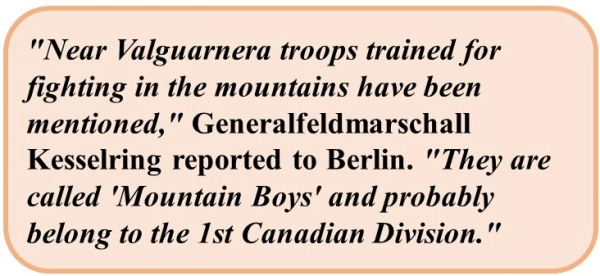
Mountain Boys - KesselringThe next town to fall was Piazza Armerina on after a day-long battle on 17 July. On 18 July, the Canadians met heavy resistance at Valguarnera, the first divisional-level battle for the Canadians in the war. There were 145 casualties, including 40 killed. German casualties were higher.
From here, the Canadians split on two axes - the 1st and 2 nd Canadian Infantry Brigades moving north towards Leonforte, and the 3rd Brigade moving east through the Dittaino Valley.

Leonforte

With sapper support in the approach, the two Canadian brigades on the northern axis were able to take the dominating 904-metre-high Monte Assoro clearing the way to the challenge of Leonforte, a significant hill town. The 2nd Canadian Infantry Brigade (2 CIB) advanced with the Seaforth Highlanders (Seaforths) in front, as far as the ravine guarding the approaches to the town. The Hastings & Prince Edward Regiment (Hasty Ps) followed on and in a remarkable feat of arms, scaled the heights into the town. At the same time, sappers of the 1st Field Company struggled to build a Bailey Bridge across the ravine, under fire from the Germans above. When the bridge opened, a column of tanks from the Three Rivers Regiment (TRR) supported by Princess Patricia’s Canadian Light Infantry (PPCLI), crossed and soon brought the battle to an end. While his sappers worked on the bridge, their commander, with a small party, took out a machine gun post and bagged 20 prisoners. After another night of house-to-house fighting, Leonforte fell on the 22nd of July. The cost to 2 CIB over the three-day fight for Leonforte was close to 275 casualties, 100 of whom were killed.

Meanwhile, by 21 July, the 8th Army was running critically short of fuel and ammunition in its advance to Catania. British troops moving along the east coast were stopped at Catania. General Montgomery’s earlier decision to bite off more than he could crew had returned to haunt him. He called another halt for everyone except the Canadians. It was for them to maintain the pressure in the centre and they were ordered to “continue without restraint directed on Adrano”.

Agira

The Germans would make certain the Canadians would pay a high price to get to Adrano. They, along with the Italians, made a determined stand with heavy fire from machine guns, artillery, and tanks along the approach routes and extracted everything they could from the advancing troops capitalizing on the terrain to their great advantage.

Before Adrano was Agira, only eight miles from Leonforte and before Agira was Nissoria blocking the route. Between Nissoria and Agira were three lines of defence – Lion, Tiger, and Grizzly. Based on their experience so far, the Canadians had not expected Nissoria to be occupied and were surprised by the ferocity of the defences they faced. Up until now, the enemy could fight when and where it wanted but as the British were pressing in Messina and the escape route from Sicily, the time had come to stop moving back in leaps and bounds, and fight where they stood.

On the afternoon of 24 July, the Royal Canadian Regiment (RCR) led the 1 CIB advance to Agira. They marched nearly unopposed through the town of Nissoria but met with a costly surprise as they approached Line LION. The TRT lost ten tanks. The RCR companies turned south of the town, and although they reached Line TIGER, they were out of touch with brigade HQ and supporting artillery. In working to link the scattered RCR companies, the battalion HQ came under fire, wounding several and killing the CO. General Simmons ordered the offence to continue and just after midnight, the Hasty Ps took over the attack on Line LION. They fought through the night as the RCR continued to cause casualties from their positions on Line TIGER. By morning, the Hasty Ps had suffered 80 casualties, the highest single-day loss of any regiment in the Sicilian Campaign, including their just-appointed CO.

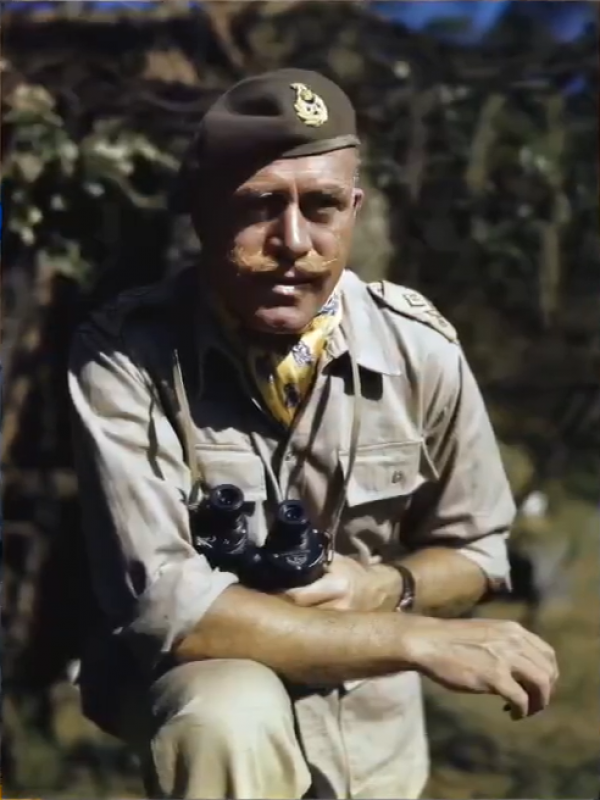
Chris Vokes in Italy
Major General Chris Vokes, originally
a Sapper officer, commanded the
2nd Canadian Infantry Brigade in Sicily

On the morning of 25 July, preparations were being made for a deliberate attack to carry through to Agira. The 48th Highlanders had carried out aggressive patrols on the heights to the north and the RCR were withdrawn to allow heavy artillery bombardment of the way ahead. 2 CIB, commanded by Brigadier Chris Vokes, relieved 1 CIB and took over the lead on 26 July. At 2200 hours that night, following a the biggest barrage used to date in Sicily, the 2 CIB infantry set off through Line LION and fought hard to Line TIGER. By the next afternoon, with control of the high ground, the Canadians drove to enemy from their reverse slope positions back to Line Grizzly, a line of hills blocking the approaches to Agira, now just two long miles away.

On the morning of 27 July, it was clear the enemy had been badly mauled but were still determined. Two battalions of reinforcement were brought in to strengthen Line Grizzly. While fire poured down on Line TIGER, the Seaforths took the initiative to move around to the southern edge of Line GRIZZLY. They scaled the rocky ridge of Monte Fronte and established a firm high-ground position to accurately direct artillery onto the defenders below. They were soon joined by the Loyal Edmonton Regiment (Loyal Eddies) who moved on Monte Cimitero. The two battalions fought off counterattacks through the night. As reported by the Loyal Eddies’ War Diary, “It was not until the enemy were engaged with the bayonet that the situation began to clarify itself.” By the morning of the 28 July, Line GRIZZLY was in Canadian hands. The cost had been high on both sides.

General Simmons’s next step called for a bombardment of Agira. However, when an artillery forward observation officer was looking for a good position, was met by townspeople reporting the Germans has left, back towards Nicosia in the American sector and north towards Regalbuto. Patrols of the PPCLI confirmed this information and by that evening facing light opposition had moved into the town with the Three Rivers Regiment. It had taken five days to get the Germans out of Agira, the toughest battle the Canadians would face in Sicily. Again, the cost was heavy. By the morning of the 28th, the two brigades fighting that action counted 438 casualties in what was the biggest Canadian engagement to date.

Catenanuova, Adrano and Regalbuto

While the 1st and 2nd Brigades were engaged in the Agira action, the 3rd Brigade was placed under command of the British 78th Division who were to advance through the Dittaino Valley with the eventual aim of meeting the rest of the division at Adrano. Initially, the going was relatively easy for the Canadians as they cleared the route for the follow-on British Division. Their task was to capture the town of Catenanuova to establish a crossing over the dry riverbed to allow the Britsh to carry on the Centuripe and on to Adrano.

The attack on the town was launched before midnight on 29 July under a heavy barrage. Sappers from a 4th Field Company platoon were split between the Royal 22e and the West Nova Scotia Regiments. The initial assault was quite successful and the West Nova Scotia Regiment forced most of the defending 923rd Fortress Battalion to run away. However, there was still determined opposition from commanding positions and particularly from a high spur to the southwest. The Royal 22 e Regiment attacked the high ground and by late morning, the heights were under Canadian control. However, small elements of the vanquished Fortress Battalion were still holding excellent observation posts north of the town and stopped the further advance of the West Nova Scotia Regiment, but more importantly, prevented any support from being pushed forward.

While the infantry was fighting, the other two platoons of the 4 th Field Company started working on two potential riverbed crossings with men and heavy equipment. Mortar and artillery fire stopped work and at first light machinegun and small arms, fire pinned them all down in the open. At around noon they concentrated all effort on one of the sites and by 1900 hours had a rough route ready to get close-support weapons over to the now hard-pressed infantry.

Catenanuov was taken on 30 July and Centuripe on 3 August. To the north, Regalbuto fell to combined Canadian and British attacks also on the 3rd of August. The Canadians moved forward through continued opposition to Adrano. They were briefly held up along the Simeto River and arrived on the outskirts of Adrano on the morning of 7 August. The British, back in action, advanced and converged on Adrano, to whom the city fell. After Adrano, the Canadians were moved back to Simeto and their fighting days in Sicily were ending.

German Withdrawal

The Germans started their withdrawal from the island on 10 August. They had planned their retreat masterfully. Despite the efforts of an American and two British divisions in their pursuit, the German engineers had used the natural defiles along the coast to their great advantage. Every conceivable obstacle was put in the way. A British division took a week to advance 16 miles along a coastal road. By 14 August, the Germans were able to break contact with the Allies and the rate of advance equalled the ability of engineers to open the routes. By 17 August, the Germans evacuated nearly 40,000 troops, 9600 vehicles, 47 tanks, 94 guns and 17,000 tons of ammunition, fuel and equipment from Sicily.

Sicily had been conquered in 38 days. The campaign was a success and even though a sizable number of Germans got across the Straights of Messina into Italy. The operation secured an air base to support the rest of the campaign on the mainland. The Mediterranean sea lanes were finally opened, and Mussolini was about to fall. Italy was able to sue for peace, and the new southern front had taken pressure off the Russian armies in the north.

The Canadians had acquitted themselves well in their first campaign. They had fought through 150 miles of mountainous country—farther than any other formation in the Eighth Army—and during their final two weeks had borne a large share of the fighting on the Army front. Canadian casualties totalled 562 killed, 1,664 wounded and 84 prisoners of war.

Read Part 3: The Role of the RCE