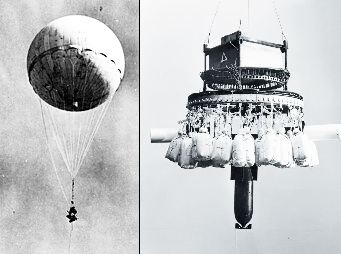
The Royal Canadian Engineers played a direct, hands on role in investigating, disarming, and analyzing Japan’s Fu Go balloon bombs that reached Canada during the Second World War. Their work focused on bomb disposal, site investigation, and technical intelligence.
Japan’s Fu Go program - an attempt to strike North America with explosives laden balloons - had its origins in 1926. Meteorologist Wasaburo Oishi charted the powerful west to east jet stream, which offered Japan’s military a potential intercontinental delivery system. After the 1942 Doolittle Raid exposed Japan’s vulnerability to American air attack, Prime Minister Tojo demanded retaliation. The answer became the world’s first intercontinental weapon: the hydrogen filled Fu Go balloon bomb.
Constructed from lightweight kozo paper, each balloon measured ten metres across and carried a deadly payload: four incendiaries, a fifteen kilogram high explosive bomb, and flash charges that were intended to erase all evidence. A barometric device controlled altitude by dropping sandbags as the balloon drifted across the Pacific. In theory, the system would keep the craft aloft for the three-to four-day, 7,000-kilometre journey to North America.
In practice, the design was riddled with flaws. Batteries froze, ballast mechanisms jammed, and winter rains across the Pacific Northwest rendered incendiaries largely ineffective. Of the 9,000–10,000 balloons launched beginning in November 1944, only about ten percent reached the North American continent.
Canada’s encounter with the Fu Go threat began on 1 January 1945 near Stony Rapids, Saskatchewan. Over the following months, at least eighty balloons were found nationwide. The most valuable recovery came on 12 January at Minton, Saskatchewan, where an almost intact balloon - still carrying bombs and ballast - was snagged on a barbed wire fence. Analysis of the sand from its weights revealed microscopic fossils unique to Honshu’s eastern shoreline, confirming the launch sites and disproving theories of submarine deployment.
Combatting the balloons proved challenging. On 21 February 1945, Flying Officer Maxwell of 133 (Fighter) Squadron achieved Canada’s first “paper kill” near Chilliwack, British Columbia, after repeated firing passes. Two more confirmed kills followed in March. The Pacific Coast Militia Rangers tracked sightings and secured crash sites, while the Royal Canadian Mounted Police and Royal Canadian Navy handled ground and maritime recoveries. Sappers focused on bomb disposal and technical intelligence.
Censorship complicated matters. A media blackout prevented Japan from gauging success but also hindered civilian reporting. The danger was real: on 5 May 1945, a downed Fu Go killed six civilians near Bly, Oregon. This was the only known wartime fatalities caused by the program.
Canada suffered no casualties, but the Fu Go campaign exposed vulnerabilities and demanded vigilance across a vast frontier. Even today, remnants occasionally surface in remote forests—quiet echoes of a strange, windborne war fought high above the Pacific.