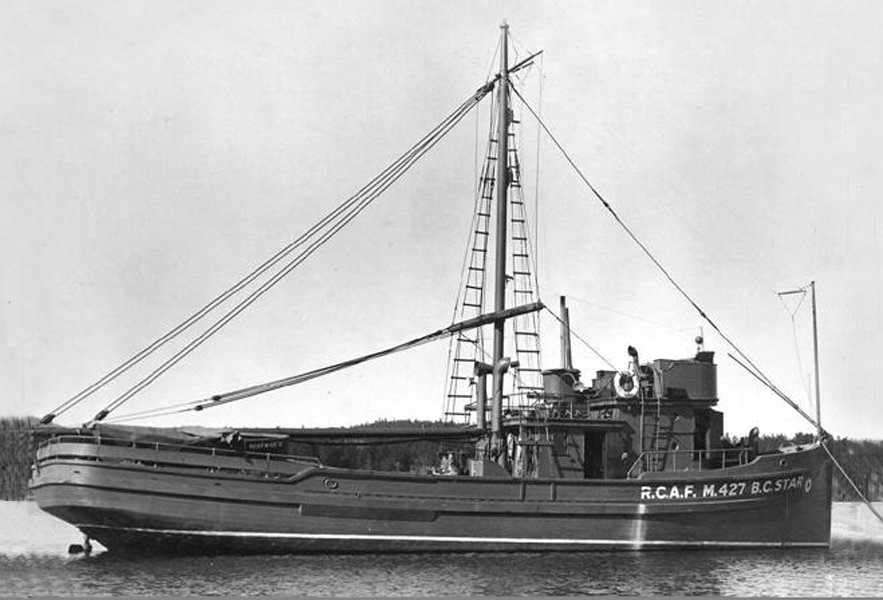
On 23 July 1943, the RCAF marine vessel M427 “BC Star” embarked on a fateful journey that would become one of the most tragic incidents in Canadian military construction history. Departing from Bella Bella, BC, the 70-ton requisitioned seine fishing boat was bound for Cape St. James in the Queen Charlotte Islands, carrying a crew of ten RCAF members, six personnel from No. 9 Construction and Maintenance Unit (9 CMU), and 43 tons of construction materials.
Taken up from trade as a supply and salvage vessel with the RCAF Marine Section, Western Air Command. The BC Star's mission was to deliver supplies to a coastal radar station under construction, part of the wartime effort to bolster defences along Canada's Pacific coast. At the time, the threat of Japanese forces loomed, with the Aleutian Islands of Alaska having been occupied since 1942.
Strict radio silence was enforced during these supply runs to maintain secrecy, and all information regarding vessel movements was classified and coded. Days passed without a word from the BC Star. The vessel was officially declared missing on 6 August. An extensive sea and air search operation was launched, but despite weeks of searching, only two bodies and some wreckage were recovered.
The disappearance of the BC Star became the single greatest loss of life during CMU operational activities in the Second World War. The incident claimed the lives of 16 men, including the ten-man RCAF crew and six 9 CMU personnel: Flight Sergeant RH Drouillard (age 31), Sergeant JD Hearfield (age 22), Sergeant JC Slater (age 36), Corporal TL Polec (age 25), Leading Aircraftman AC GT Stead (age 21) and Aircraftman 1 T Vollhoffer (age 19).
The exact cause of the BC Star's disappearance remains a mystery. Rumours circulated about a possible Japanese submarine attack. Some speculated that the hull might have opened up under the weight of the cargo, causing the vessel to sink rapidly without time to launch lifeboats or send distress signals.
The loss of the BC Star had a profound impact on RCAF operations. As a result, marine craft procedures were revised to ensure prompt reporting of arrivals and departures. On 8 March 1944, over seven months after the incident, Air Force Headquarters officially announced that the personnel lost on board were presumed dead.
Due to wartime secrecy, the sinking of the BC Star never gained widespread publicity. However, the men who perished are commemorated on panel two of the Commonwealth Air Forces Ottawa Memorial, dedicated to air force personnel lost without trace in Canada, the United States, and neighbouring lands and seas during the Second World War.
The BC Star tragedy serves as a sad reminder of the risks faced by the members of the RCAF Construction and Maintenance units who served during the Second World War.