

By: Lynn Capuano, Army Public Affairs
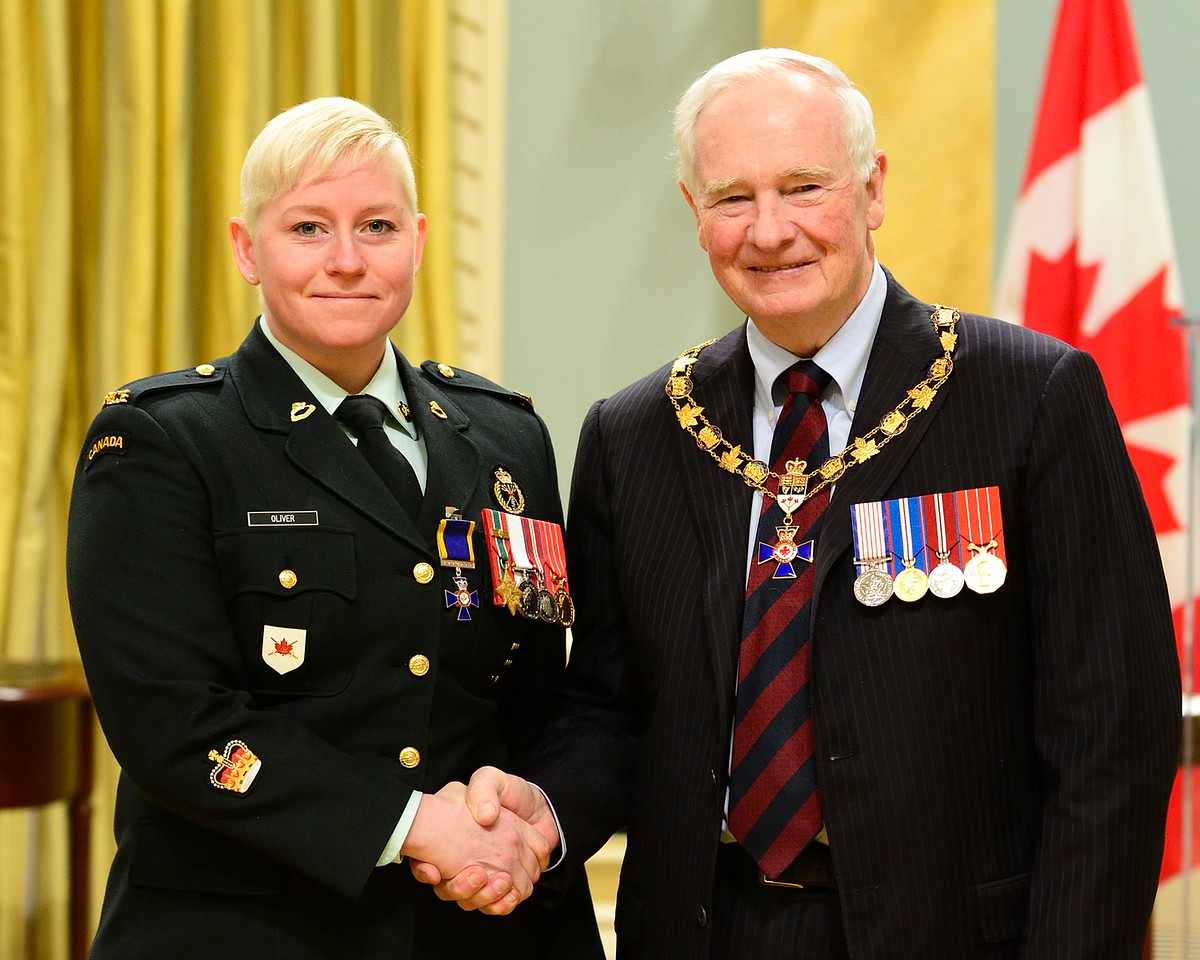
Gagetown, New Brunswick — Warrant Officer Erica Oliver, who recently became a Member of the Order of Military Merit, is the only currently serving woman combat diver in the Canadian Army (CA). These shining achievements are just two of many for this veteran of two tours in Afghanistan who chose her life’s work at the tender age of four years.
The theme for International Women’s Day this year is “Make it Happen!” That certainly fits well with a series of phrases that WO Oliver includes in her email signature block: AIRBORNE! DIVE ARMY! FIGHT TO LIVE! BUBBLES UP!
“Those words summarize both my world view and some of the amazing courses I have been lucky enough to have had the opportunity to attend and succeed in passing,” said WO Oliver. “ In the military, sometimes our signature block can tell the reader a lot about the person they are dealing with.” “‘AIRBORNE!’ signifies that I am a parachutist – another method of getting to where the job needs to be done. ‘DIVE ARMY!’ is our way as Army divers of distinguishing ourselves from Navy divers as we do very different work. ‘FIGHT TO LIVE!’ is the motto of the Close Quarters Combat Instructors. And ‘BUBBLES UP!’ is the unofficial motto of the Combat Divers,” she said.
This 18-year veteran of the Army became a Member of the Order of Military Merit in 2014, and received her badge from His Excellency the Right Honourable David Johnston, Governor General of Canada at a ceremony at Rideau Hall in Ottawa on February 26, 2015. This award recognizes exceptional service or performance of duty displayed by the men and women of the Canadian Forces.
“I am going to be completely honest, I feel strange about this award,” said WO Oliver. “I feel unbelievably humbled by it, but I still don’t think I did any more than I was put here to do.”
WO Oliver, whose grandfather was a British commando, says she knew from a very young age that she wanted to become a soldier. “I knew since I was about four years old. Not only because of my grandfather – I just knew,” she said. “I didn’t want Barbie dolls, I wanted GI Joes.”
She joined the Reserves at 17 in her home town of Halifax, “I was as young as you could possibly be. I got my Dad to sign for me,” she said, and was deployed on domestic operations such as the Ontario-Quebec ice storm of 1998. “We did everything from cut down trees to help the elderly out of their homes and into emergency shelters. It was a pretty horrific eye-opening experience for Canadians in general, I think. I don’t think we realize just how dependent we are on electricity.”
“When I was on an exercise as a Reservist with the Black Watch [Royal Highland Regiment], I saw a combat diver demonstration in Valcartier. I saw these guys all in black coming out of the water all ‘cammed’ up [faces camouflaged] and it was just like an epiphany. I said, ‘that’s it, that’s what I’m doing in this world, I need to go do that,” said WO Oliver.
She discovered that in order to become an Army combat diver, first she had to become a Regular Force combat engineer. “I said, ok then, sign me up.”
Combat Engineers are first in, last out of any operation, ensuring that troops can live, move and fight on the battlefield. They maintain and operate vehicles and equipment used to build or demolish facilities such as roads, airfields, bridges and buildings; maintain and operate weapons systems; deploy, detect and dispose of mines and explosives; construct field defences and obstacles; purify local drinking water; and provide engineer communications on the battlefield.
WO Oliver set about learning the trade of combat engineer, adding urban, mountain and Arctic operations skills, close quarters combat instructor and parachutist to her combat engineer repertoire.
“It’s not so special,” said WO Oliver. “A lot of people who are my rank in the combat divers are all these things as well. These challenging courses tend to draw the same sorts of personalities.”
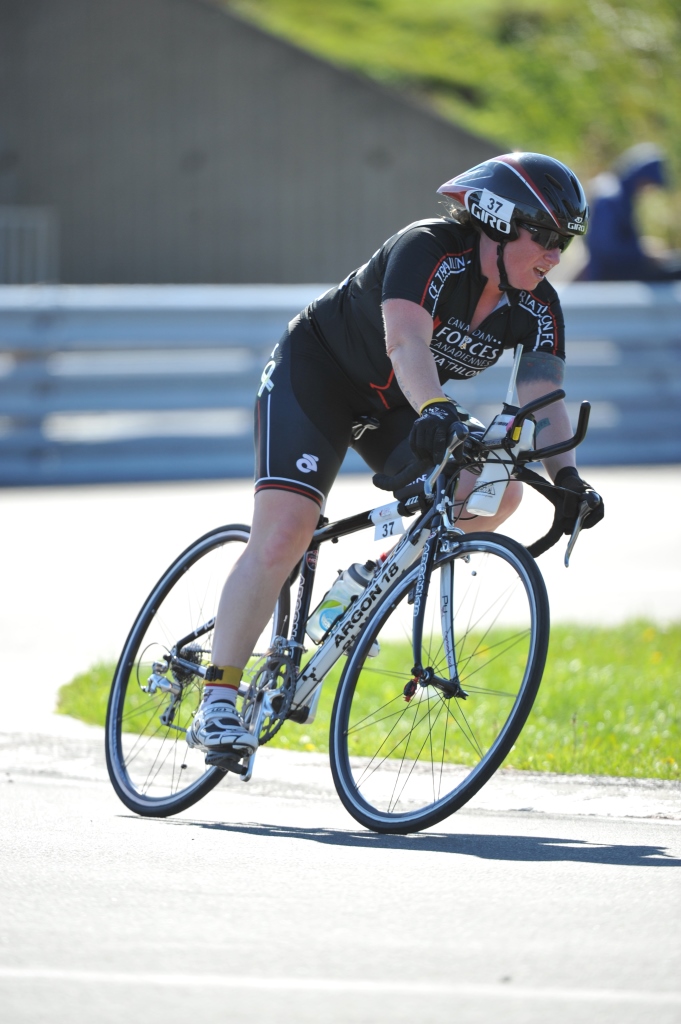
“Physical fitness is very important to us. We are all athletes, so we enjoy it,” she said. “Hockey, soccer, biking, running, you name it, I like to compete in it.”
WO Oliver plays hockey at the regional and national levels, including in a men’s B team, holds14 Canadian power lifting records and competed in the 2011 Montreal Esprit IRONMAN triathlon with a time of just over 14 hours. “Loved it,” she said. “And happy to get through it!”
“It’s a very physically demanding trade and women naturally aren’t as strong as men, so I train twice a day to keep up,” she said. “If that means I have to bust my butt at the gym and pass on the chocolate cake, so be it. This is my life’s calling.”
“In my 18 years in the military, I’ve rarely felt discriminated against,” she said. “The very, very few times I might have felt like that I just put it in my pocket and used it as fuel. Ok, is that what you think? Watch this.”
“My father told me I was like that as a child and that I wasn’t that much fun to raise. My dad told my husband when we got married: Remember one thing, Scott, if you want her to do something, tell her she can’t.”
“Being strong is very important for our trade, because at any time, you have to be able to pick up the man next to you and get him out of there,” she said. “And he has to believe that you can.”
Learning the trade took time, and because duty called her to Afghanistan in 2004, it was four years from the time she signed up until she became a combat diver in 2005.
“Basically, combat divers take all aspects of combat engineering and apply those skills under water for whatever reason,” she said. Combat engineers ensure troops can move and fight safely (mobility), block or impede enemy movement (counter mobility) and perform a number of tasks to keep the troops safe (survivability).
Combat divers may perform underwater construction, underwater cutting in support of recovery operations, and underwater obstacle removal or placement as needed. Combat divers can also conduct tactical operations where the utmost stealth is required – just as WO Oliver remembers from her first glimpse of combat divers when she was a Reservist.
She said the Army and Navy divers differ in both equipment and mandate. Army combat divers may work in rivers and lakes as well as in shallower ocean shoreline areas while Navy divers work in waters of over 100 feet deep.
She returned for another tour in Afghanistan in 2009 where she was employed as a Combat Engineer section commander. This tour saw her come home to Canada in October of that year, but after a couple of months leave, she was deployed to Haiti following the devastating earthquake in January 2010. As the reconnaissance sergeant, her main task was to scope out suitable areas for troops and equipment and to explore whether Army combat divers could help. She quickly determined that the large-scale destruction was beyond any combat diver capability, requiring industrial commercial dive ships.
WO Oliver became a combat diver supervisor in 2010 and has been the Sergeant Major of the Army Dive Centre at the Canadian Forces School of Military Engineering for the past three years. Located at Canadian Forces Base Gagetown, she helps to oversee all combat diver courses and assists with a month-long annual international combat dive exercise called Exercise ROGUISH BUOY.
The extremely challenging preliminary dive course is generally two weeks in length. Although about 30 soldiers may begin the course, about three-quarters will quit by noon of the first day and only five or six will typically finish, according to WO Oliver. “The prelims are extremely difficult, designed to be physically and mentally challenging – for several reasons: to tire the person out physically and mentally so their true character comes out. Then we can actually start to assess them to see if they can still think under these adverse conditions and if they can still analyze and assess, they are still safe and are not a liability.”
“I find it really interesting that the theme for International Women’s Day this year is “Make it Happen!” because that’s kind of the Engineers’ motto, you know, it’s just ‘let’s make it happen’ and we always do.”
Reprinted from Army News: Article / March 6, 2015 / Project number: 15-0042
http://www.army.gc.ca/en/news-publications/national-news-details-no-men…